
RMD Rules for 2026: Smart Planning Strategies for Retirees


RMD Rules: Smart Planning Strategies for Retirees
Confused about the RMD 2026 rules? Learn how retirees can plan withdrawals, manage taxes, and avoid costly RMD mistakes with confidence.
Understanding Required Minimum Distributions (RMDs)
Most retirement accounts are built around tax deferral. You contribute, the money grows, and taxes are pushed into the future. At some point, the IRS requires withdrawals so those dollars become taxable. That’s where Required Minimum Distributions, or RMDs, come into play.
For many retirees, RMDs start to matter once retirement planning becomes more tangible. Income needs are clearer. Taxes carry more weight. Cash flow decisions begin to overlap with long-term goals. RMDs often sit right at the center of those conversations for individuals planning ahead with a fiduciary advisor at Winthrop Partners, including clients in Pittsburgh, Buffalo, and Doylestown (Philadelphia area).
What Is a Required Minimum Distribution?
A Required Minimum Distribution is the minimum amount you must withdraw each year from certain retirement accounts once you reach a specific age. The calculation is based on your prior year-end account balance and IRS life expectancy tables.
For official definitions and calculation guidance, the Internal Revenue Service provides detailed explanations on its Retirement topics – Required minimum distribution (RMDs) resource page.
How RMDs Affect Retirement Accounts
RMDs typically apply to:
• Traditional IRAs
• SEP and SIMPLE IRAs
• 401(k) and 403(b) plans
Roth IRAs work differently. Because they are not subject to RMDs during your lifetime, some retirees explore Roth conversions well before RMD age as part of a comprehensive retirement planning approach. At Winthrop Partners, it’s our fiduciary responsibility to evaluate this strategy alongside investment management, tax considerations, and long-term income needs, helping clients make informed and coordinated decisions over time.
Learn more about how thoughtful withdrawal planning fits into a personalized retirement plan through Winthrop Partners’Retirement Planning Services.
What’s In Effect for RMDs in 2026 Under Current U.S. Law
These rules reflect current law, largely from the SECURE 2.0 Act of 2022 and IRS guidance.
1. The RMD Starting Age Has Changed (Already in Effect for 2026)
The age at which most retirees must begin taking RMDs from traditional IRAs and employer-sponsored retirement plans is 73, up from 72 under prior law.
This change applies to individuals who reach age 72 after 2022 and age 73 before 2033.
For those who attain age 73 after December 31, 2032, the RMD age will rise again to 75 beginning in 2033.
2. First RMD Timing and Deadlines
Your first RMD must be taken by April 1 of
the year after you reach age 73. For example, if you turn 73 in 2025, your
first RMD can be taken as late as April 1, 2026.
If you wait until April 1 for your first
RMD, you’ll also need to take your next RMD by December 31 of that same year.
That means two taxable withdrawals in one calendar year.
3. Penalty for Missing an RMD Has Been Reduced
The penalty structure has changed:
• Prior penalty: 50 percent excise tax on the amount not withdrawn on time
• Current penalty: 25 percent, reduced to 10 percent if the shortfall is corrected within a specified correction window, typically two years
This reduced penalty applies to RMDs taken in or after the years the law was amended, including 2026.
Detailed penalty guidance is available directly from the IRS on its Retirement plan and IRA required minimum distributions FAQs resource page.
4. Roth 401(k) and Roth 403(b) RMD Changes
RMDs no longer apply to Roth accounts held inside employer-sponsored retirement plans during the original owner’s lifetime. This change brings Roth 401(k) and 403(b) plans in line with Roth IRAs.
It’s important to note that RMDs still apply to inherited Roth accounts once they pass to beneficiaries
5. Qualified Charitable Distributions (QCDs) and Other RMD-Linked Features
While not new for 2026, related rules continue to apply.
IRA owners age 70½ and older can make Qualified Charitable Distributions up to an indexed limit, around $111,000 for 2026. These distributions can count toward satisfying an RMD while supporting charitable goals.
.
The “RMD Tax Buildup” and Why Planning Matters
RMDs rarely exist in isolation. When they aren’t coordinated with the rest of your income, they can create ripple effects across your financial picture.
Higher taxable income may:
• Push you into a higher tax bracket
• Increase Medicare premiums through IRMAA surcharges
• Cause more of your Social Security benefits to become taxable
Because RMDs interact with taxes, investments, and cash-flow needs, they’re often addressed alongside a broader investment management and retirement income strategy.
For many retirees in Pittsburgh, Buffalo, and Doylestown, these effects become more noticeable once RMDs overlap with Social Security and Medicare.
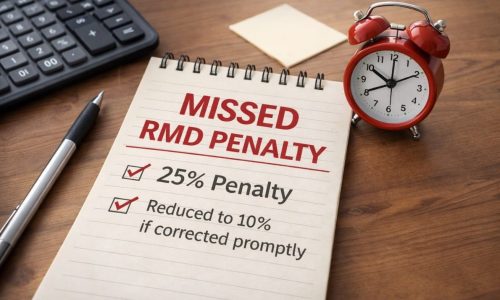
Missing an RMD can still be costly. The
current penalty is 25 percent of the amount not withdrawn, though it may be reduced to 10 percent if corrected promptly.
Automated withdrawals and regular account reviews can help reduce the risk of missed deadlines. For detailed calculation and penalty guidance, retirees can review resources provided by the Internal Revenue Service.
Every situation is different, but common planning approaches may include:
These strategies tend to be more effective when they’re part of a long-term plan rather than decisions made late in the year


FAQs About the RMD 2026 Rules
Who must take an RMD in 2026?
Generally:
• Anyone turning 73 in 2026 must begin RMDs and take their first distribution by December 31, 2026, or delay to April 1, 2027. If the first RMD is delayed until April 1, 2027, a second RMD for 2027 must still be taken by December 31, 2027, resulting in two taxable distributions in the same calendar year.
• People who turned 73 in 2025 and didn’t take their first RMD by December 31, 2025 must take it by April 1, 2026, and also take a second 2026 RMD by December 31, 2026
• Anyone older than 73 who is already subject to RMDs must take their required 2026 distribution by December 31, 2026
In addition, certain beneficiaries of inherited retirement accounts may be subject to RMD requirements. IRS Retirement topics – Beneficiary provides more detail
What’s the penalty for missing an RMD?
The penalty is 25 percent of the missed amount and may be reduced to 10 percent if corrected within the allowed correction window.
Can I delay my first RMD?
Yes. Your first RMD can be delayed until April 1 of the following year, though doing so may result in two taxable withdrawals in one year.
Are Roth IRAs subject to RMDs?
No. Roth IRAs are not subject to RMDs during the original owner’s lifetime.
Does Pennsylvania tax RMDs?
Pennsylvania generally does not tax qualifying distributions from retirement plans, including RMDs, provided certain conditions are met. Because individual circumstances can vary, it’s important to review Pennsylvania tax rules or consult a tax professional to confirm how these rules apply to your situation.
Planning Ahead Before RMDs Begin
RMD rules can feel complex, but they also create planning opportunities. With enough lead time, retirees can coordinate withdrawals with taxes, Medicare costs, and long-term income goals.
If you’re approaching RMD age or want to better understand how these rules fit into your broader retirement picture, a conversation with a fiduciary advisor can help clarify your options.
👉 Schedule a consultation with a Winthrop Partners’ advisor serving Pittsburgh, Buffalo, and Doylestown.
You can also explore more insights on retirement and investing in our blog.
Winthrop Partners is an SEC-registered investment adviser. Registration does not imply a certain level of skill or training. The information provided is for informational purposes only and should not be considered investment, legal, or tax advice. All investments carry risks, including the possible loss of principal. No advice or recommendations are being provided in this advertisement, and you should consult a qualified professional before making any financial decisions. Past performance is not indicative of future results.
Brian Werner is a Managing Partner at Winthrop Partners. He has more than 25 years of experience in investments, financial planning, entrepreneurial ventures, corporate finance, and banking. Prior to joining Winthrop Partners, Brian was the First Vice President and a Senior Wealth Advisor for First Niagara, where he led the development of First Niagara’s Western Pennsylvania Private Client Services and served on its western Pennsylvania operating committee. He also held roles with PNC/National City, Greycourt Investment Advisors, and Linnco Future Group, Chicago Board of Trade. Brian is a Chartered Financial Analyst and Certified Financial Planner. He earned his MBA from Duquesne University, Magna Cum Laude.